सड़क पर एक औरत
There is a woman walking through the streets of Savatthi with a dead child on her hip. She is holding him the way mothers hold children who have fallen asleep. One arm underneath, the weight settled against her side, his head resting on her neck. From far away, nothing looks wrong.
That is the first thing to understand about this story. From far away, nothing looks wrong.
She stops at a door and knocks. A man opens it & she says the thing she has been saying since the middle of the morning.
मेरे बच्चे के लिए दवा चाहिए।
He looks at the child. Then at her. Then back at the child.
दवा? इसके लिए?
She has heard this at four houses already. She will hear it at forty more. Some people shut the door. Some say something kind and useless. Some call out to a neighbour, quietly, the way you do when the person in front of you has lost their mind and you would rather not be alone with them.
She keeps walking. She keeps knocking. She keeps asking for medicine.
This happened, or something like it happened, about two and a half thousand years ago, on the plains near the Ganga. We know her as Kisa Gotami. And what happens next has been told so many times, in so many versions, that nobody notices anymore how strange it actually is.
Because here is the strange part. She finally finds someone who says yes. Someone who agrees to bring her dead son back. And that person does not lie to her. Well, actually he does lie to her & we’ll come to that. But he does not comfort her & he does not explain anything at all.
He sends her on an errand.
That’s the story. Most people know roughly this much. What most people don’t know is that there are four different versions of it in the sources, that they disagree about things that matter & that the poem which survives under this woman’s own name describes a catastrophe so much larger than the one in the famous story that scholars still argue about whether the two are even about the same person. Something was done to this story on its way to you. A very long line of hands passed it along & somewhere in there it changed shape. The most human part of this whole account is what got changed & why.
We’ll get there. But first you need to see the city she was walking through, because almost nobody bothers to describe it & without it she’s just a sad woman in a void.
The city she was walking through
Savatthi (Shravasti, if you want to find it on a map today, in eastern Uttar Pradesh near the Nepal border) was not a village. It was one of the great cities of its world. It was the capital of Kosala, which was one of the two superpowers of northern India at the time, the other being Magadha to the south-east. Kosala’s king was Pasenadi, a man who appears repeatedly in the texts, sometimes asking intelligent questions and sometimes being managed like a difficult customer. The city sat on the Aciravati river. It had walls, gates, markets, guilds, courtesans, caravan traffic & the enormous mixed population of any place that money flows through.
And just outside it was a grove called Jetavana.
Jetavana was bought for the Buddha’s community by a merchant named Anathapindika, who according to tradition paid for it by covering the ground in gold coins, the price the owner had sarcastically named to get rid of him. Whether or not that detail is literal, the underlying fact is solid: a very rich businessman spent an enormous amount of money on a park for a group of homeless mendicants & the Buddha spent more rainy seasons there than anywhere else. A large fraction of everything he is recorded as saying, he said in that grove.
So picture the geography properly. On one side, a big noisy commercial city. On the other side, a quiet grove full of people who had walked away from exactly the sort of life the city was built to produce. And a woman walking from one to the other with a dead child. This matters for a reason that isn’t sentimental. She is not going to a temple. She is not going to a priest. There is no institution in this story, no ritual, no ceremony. She is walking out of a city to a park to ask a man for medicine. Whatever happens next happens between two people standing on grass.
Now, what was it actually like to live there? Because there’s a version of ancient India in most people’s heads that’s mostly wrong. Not golden, not primitive. Something much more specific. The cities were real cities: brick buildings, drainage, planned streets, long-distance trade. This was a couple of centuries into what historians call the second urbanisation of India & the money was new and the social order was being renegotiated constantly. That’s precisely why the period produced so many wandering teachers arguing about everything: the Buddha, the Jains, the fatalists, the materialists, half a dozen schools all competing in public. New wealth, new cities, old rules coming apart. People had questions.
And underneath all of it, the thing that never gets into the picture: death, constantly, at every age, in every house, as ordinary background.
The girl who was too thin to marry
Her name was Gotami. That’s all.
The Kisa came later & it was not a compliment. Kisa in Pali means lean. Thin. Skinny. Bony. She was so thin that people started calling her Gotami the Lean & the name stuck so hard that today it is the only name we have for her. Two and a half thousand years later, we still know this woman by the thing people used to tease her about.
Stop and sit with that for a second. Every kingdom that existed while she was alive is gone. Kosala is gone. Pasenadi’s dynasty is gone. Her nickname survived all of it.
She was born into a poor house. And she was thin in a world where a thin woman was not admired at all. A full body was beauty. Flesh meant health, money, proof that a family had food on the table. A thin girl meant a house with nothing in it. And a thin girl looked like trouble coming: trouble in childbirth, trouble in the fields, trouble everywhere. So when it was time to marry her off, it was hard. The sources are blunt about it. Nobody wanted her. She was married anyway, eventually. And she walked into her husband’s house carrying nothing, from nowhere, with a body his family had already decided was a defect. They were not warm to her. She was the बहू in name. In practice she was closer to staff.
I want to be exact about what that meant, because “her in-laws were unkind to her” sounds like a domestic inconvenience and it was not that.
A woman in that world had no independent economic existence. She did not own land. She could not inherit in any reliable way. She could not earn. Her entire physical security (food, shelter, protection from violence, a place to sleep) came through her position in a household & that position was not a right. It was a standing she had to maintain. If they threw her out, there was nowhere to go. Her own family had already been relieved to be rid of her. So when the texts say her husband’s family scorned her, what they are describing is a woman living every day at the edge of destitution, inside a house, surrounded by people, entirely dependent on the goodwill of people who had told her plainly she was not worth much.
And then she had a son.
What a child was worth
Now here is the part that almost every retelling leaves out & without it the whole story collapses into a sad little tale with a moral stuck on the end. That boy was not just her child. He was her position. The day she gave birth to a son, she stopped being the thin girl nobody wanted and became the mother of the heir. Her worth in that house was not something she was born with. Nobody granted it to her. It arrived with him.
It was him.
So she loved him the way any mother loves her child. And on top of that, tangled up with it and impossible to separate from it, she needed him, in the hard, unromantic, practical sense of needing someone. He was her food. Her place. Her safety. Her name. Her old age.
This is worth pausing on because we have a slightly dishonest modern habit of talking about love as though it were pure, as though needing someone contaminates loving them. In most of human history the two have been the same thing. You loved the people you survived through. Nobody thought this was a problem. The idea that love should be free of need is extremely recent and mostly available to people who are already safe.
And she would have expected to lose him. Not this one specifically. One of them, probably.
I want to be careful here, because this is where writers start inventing statistics. We have no census data from Kosala. Nobody counted. What we do have is every pre-modern society anyone has managed to measure & in those, child mortality is consistently, brutally high: a large fraction of children not reaching five. I’m not going to attach a number to ancient India that nobody can support. But the qualitative fact is not in doubt, because the texts themselves tell you. This is a literature in which dead children are ordinary. They turn up constantly, without special comment, as the normal furniture of life. A woman who gave birth several times expected to bury at least one & would not have considered herself unlucky.
Think about what that does to a place. Every woman on that street had buried a child or knew she probably would. Every single one. It was not a catastrophe that happened to some families. It was the weather. Which makes what happens later in this story much stranger, not less strange. She is about to knock on fifty doors and discover that everyone has lost someone, in a society where she must have already known that. She had seen the funerals. She had been to them.
So why did she need to knock on fifty doors to find out something she already knew ? Hold that question. It’s the key to the whole thing.
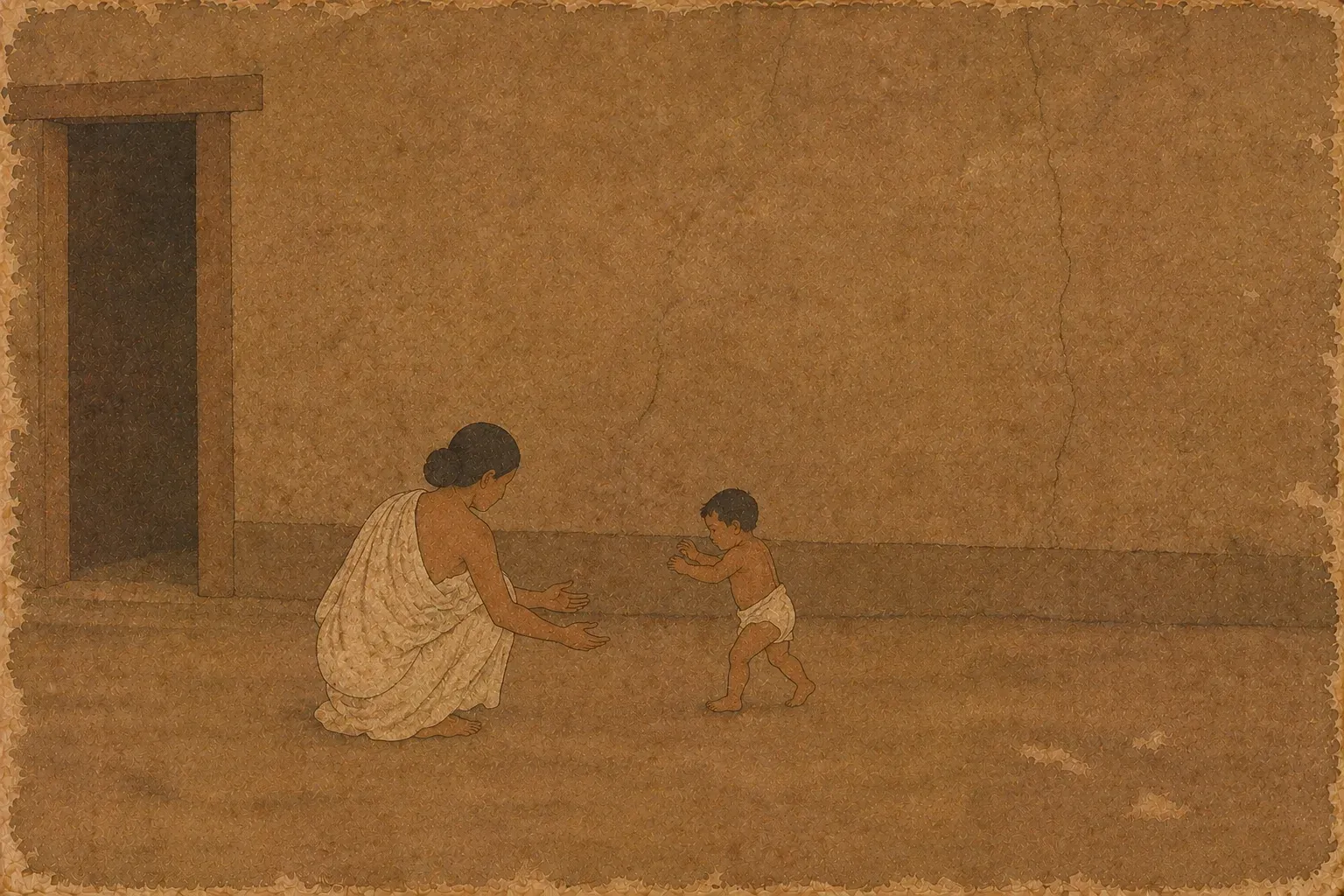
He learned to walk. And a little while after that, out in the street, he fell over.
And he didn’t get up.
She would not put him down
The easy way to read what happens next is that grief broke her. She went door to door with a dead body asking for medicine, people thought she was mad & this is a story about a woman losing her mind. I don’t think that’s right. I think what actually happened is far more interesting. Look at what she did. She didn’t scream at the sky. She didn’t tear her hair, or faint, or stop functioning. She looked at her son lying still in the dirt and she reached a conclusion.
He is unconscious. There is something that will wake him. I don’t know what it is. But somebody in this city does.
That is not madness. That is a plan. It’s a wrong plan, built on something that isn’t true, carried out with total commitment. But it has its own logic & she followed that logic with a stubbornness most people never manage about anything in their whole lives. And by the way, this is what denial actually looks like. People think denial is stupidity. Refusing to see the obvious. It is almost never that. Denial is what happens when the mind runs into a fact it cannot survive & then quietly, efficiently, builds a different fact to stand on instead. It is not the mind failing. It is often the mind working at full power, in service of something that is not allowed to be true.
Her mind had already done the sum. If the boy is dead, then everything is gone. The child, the position, the house, the name, all those years of proving herself, the old age she was counting on. The mind looked at that total and said: no. Not available. Find another answer. So it found one. The child is sick. Sickness has medicine. Medicine exists somewhere in this city. And she went out to find it, with him on her hip, in the heat, door after door, for as long as it took.
Here’s the thing that’s true of everyone and not just her. We don’t usually refuse to believe a fact. We refuse to believe what the fact costs. She was not arguing about whether her son was breathing. She was arguing with the bill. And this is why the question from the last section matters: why did a woman who already knew children die need to be shown that children die? Because knowing it about other people’s children is a completely different kind of knowing. She had held that fact her whole life the way we all hold it: as information about the world, filed somewhere safe, true in general and not about me.
Everybody knows everybody dies. Nobody knows it. You know it right now, reading this. You know that everyone you love will die & that you will & you’re fine. You’re reading an article. That’s not a criticism, it’s just what minds do: they hold the fact at a distance where it can’t operate on you. She had it at that distance too. Then it came for her son and the distance collapsed & the mind did what minds do when the distance collapses.
It refused delivery. Somewhere during that walk (and the text doesn’t say who, which I find strangely moving, because it means some nameless person in Savatthi is responsible for everything that follows), somebody stopped her and said something different.
Not of what use is medicine. Not इसे नीचे रख दे, बहन।
बुद्ध के पास जा। उनके पास दवा है।
The text does not say who, which means some nameless person in Savatthi is responsible for everything that follows. Maybe they meant it kindly. Maybe they only wanted her off their doorstep. We have no idea.
But she went.
हाँ। मैं ठीक कर दूँगा।
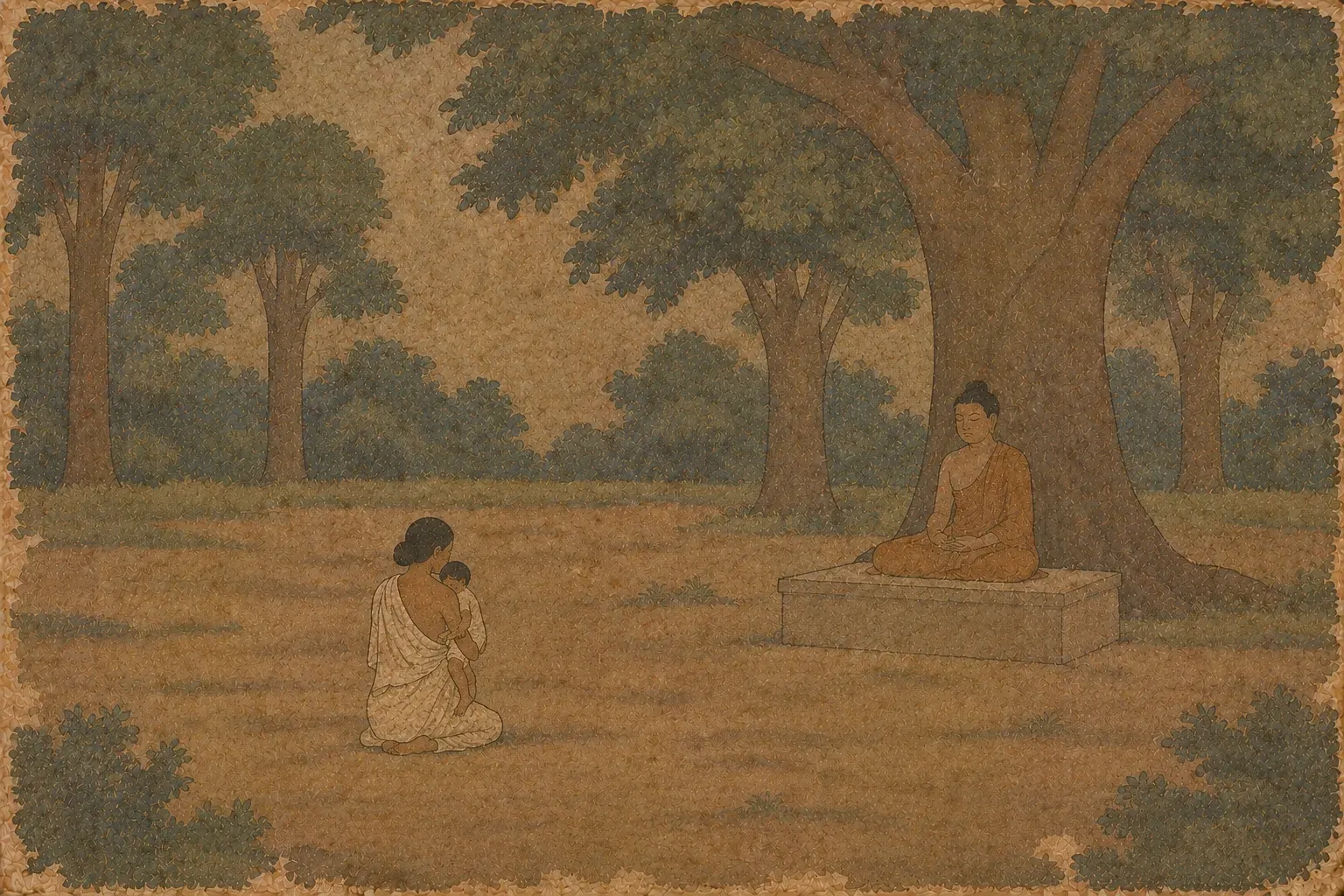
The grove was cooler than the road. There were people sitting under the trees in ones and twos & nobody stopped her & she walked through them until she found the one she had been sent to, sitting on a low stone seat with his hands in his lap.
She knelt down in front of him and shifted the boy off her hip and into her arms so that he could see him properly.
मेरे बेटे के लिए दवा चाहिए।
He looked at the child for a while.
हाँ। मैं बना दूँगा। एक चीज़ चाहिए बस।
He did not correct her.
There was a woman kneeling in front of him holding a dead child and asking for something that does not exist & he did not say बहन, तेरा बेटा जा चुका है। He did not explain that everything ends. He did not teach her anything or offer her sympathy. He told her he could make the medicine & that he needed one ingredient.
Consider how much holding back that is.
Every instinct in a decent person, faced with someone in that state, is to tell them. Gently, kindly, but tell them, because the lie feels cruel and the truth feels like the first step to getting better. We have a whole vocabulary for this now. Help them accept it. Bring them back to reality. Don’t feed the delusion.
He did none of it. He met her exactly where she was standing, inside her own false story & agreed to it. And I want to say clearly: this is a lie. Not a technicality, not a skilful ambiguity. He tells a grieving woman he can revive her dead child, knowing he cannot. Some retellings try to soften this by suggesting he meant a different kind of medicine, or that he was speaking on two levels. Maybe. But the plain reading of the text is that he says something false in order to get her to do something.
We’ll come back to whether that was allowed. It deserves its own argument and it’ll get one.
Then he named the ingredient. White mustard seed. Siddhattha, in Pali. Now, सरसों.
Not a rare herb from some mountain. Not something locked in a temple. Not anything that needs a journey. Mustard seed was the cheapest spice in India then & arguably still is. It was in every kitchen in that city. It was in the kitchen of the poorest house on the worst street. हर घर में थी। She could have found it in thirty seconds. He gave her a task that was, in every practical way, extremely easy.
And then he added the condition.
The cheapest spice in India
The seeds had to come from a house where nobody had ever died. Not a child. Not a parent. Not a husband or a wife. Not a servant. Nobody, ever.
Sit with the design of that, because it is one of the most carefully built things anyone has ever said to another human being.
He did not give her an impossible task. That would have been cruel in the ordinary way: send the grieving woman up a mountain to find a flower, keep her busy, let exhaustion do the rest. Plenty of traditions have stories like that. Plenty of religions run on it. He gave her a completely possible task with an impossible condition, which meant she would not fail once, at the end, after a long journey. She would fail at every single door, immediately, again and again, all afternoon.
Look at what each of those two halves is doing.
The seeds being cheap and everywhere is what keeps her walking. Ask for something rare and she goes to one place, fails & comes back defeated with the fact undiscovered. Because it is only mustard seed, every door opens. Every door says yes. She gets all the way inside the conversation, every time.
The condition being impossible is what turns each of those conversations into a small piece of information. He was sending her to find something out & he arranged it so that she would find it out from her own neighbours, in her own language, on her own street. Not from him.
A test asks whether you can do something. A doorway only needs you to walk through it. She thought she had been given a test.
One more thing about the design, which took a while to see. He did not ask for a house where no child had died. He asked for a house where nobody had died. Parent, husband, wife, servant, anyone.
That is a much wider net & it is deliberate. Ask for houses where no child had died and she collects stories exactly like her own, which is a kind of misery tourism & might only have confirmed that her particular sorrow was the important one. By widening it to everyone he made the thing she discovers not other mothers have lost sons but something much larger and stranger.
Which brings us to the walk.
Every door said the same thing
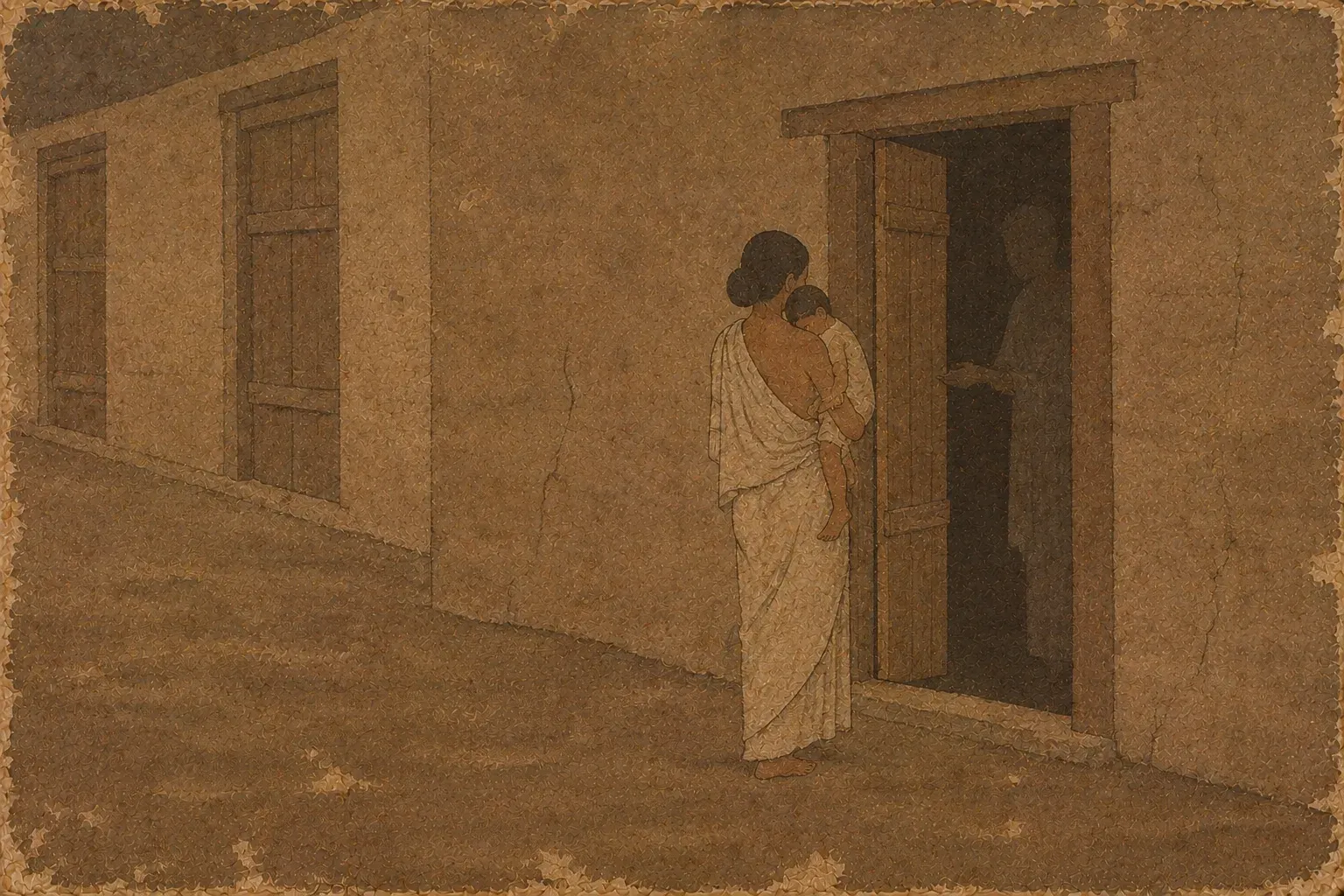
So she went.
The first house on the grove road had a low mud wall and a courtyard with a grinding stone in it. A woman was working the stone and looked up and saw the child and did not ask about him, which was its own kind of kindness.
थोड़ी सरसों चाहिए।
The woman went inside and came back with a handful & held it out.
ले लो बहन।
Kisa Gotami put out her hand & then stopped.
एक बात पूछनी है। इस घर में कभी कोई मरा है?
The woman’s hand stayed where it was, open, the seeds sitting in it.
हाँ। And then, after a moment: मेरा बेटा।
She did not take the seeds. She said something, she does not remember what & went on to the next house.
मेरे माँ-बाप।
Next. पति।
Next. एक नौकर था। बहुत साल पहले, पर था।
By the fifth house her arms had begun to shake & she moved the boy across to the other hip, which helped for a while and then did not. A child who has learned to walk is not a baby anymore. He had the weight of a sack of grain and none of the balance & he had been in her arms since the previous day.
The streets that afternoon smelled of cooking smoke and cattle and hot brick. Somewhere behind a wall a woman was grinding something and singing along with it, badly. Dogs lay in the strips of shade against the walls and did not get up as she passed.
At one house an old man looked at her for a long moment and then went inside and came back with water in a brass bowl and gave it to her without saying anything at all. She drank it standing in his doorway with the boy against her shoulder & handed the bowl back & asked her question. He had buried a wife and a daughter. He told her about both of them and she stood there and listened to all of it, because there was no polite way to leave & because by then some part of her had begun to want to hear it.
The shadows moved across the street and got longer. The heat came off the walls even after the sun had gone off them.
And in the doorways, as the light went, people began lighting the evening lamps. Small clay दीये, one at each threshold, the way they were lit every evening in that city and the way they are still lit now. She would have walked past thirty of them without seeing a single one.
House after house after house. Every one had the seeds. Every one had a death. Nobody turned her away. Nobody was unkind to her. They all gave her exactly what she had asked for & then, without meaning to, they all gave her something else.
Think about what that afternoon sounded like from the other side of those doors. A stranger comes and asks an odd question about your dead. You answer, because it is a small question and she seems to need it. You do not think about your dead son very often, there is food to cook and there are things to do, but now you are thinking about him, because a woman at your door asked & for a second you are back in that year. Then she leaves and goes to the next house and does it again.
Fifty households, each one briefly opened. Fifty people standing in their doorways remembering someone, in one afternoon, in one neighbourhood, because of one question.
She walked through her own street and woke up all of its dead.
And nobody taught her anything.
There was no lecture. No scripture, no sermon, no explanation. The lesson was not handed to her in one piece by a wise man sitting under a tree. It was spread across an entire city, one small piece per household, delivered by ordinary people who had no idea they were teaching anybody anything. They were answering a question about their own dead. Fifty strangers, each holding a single fragment of the thing she needed to understand & she put it together herself, on foot, in the heat, over the course of one afternoon.
Consolation is something one person hands to another. This was something she had to build with her own hands.
मरे हुए, ज़िंदा लोगों से ज़्यादा हैं!
Somewhere on that walk the text has someone say the line the whole story rests on. In any house, the dead outnumber the living.
In your house too. In mine.
Count backwards. Two parents. Four grandparents. Eight behind them, sixteen behind them. Keep going and within a few hundred years you are standing on thousands of people. Go back as far as Savatthi and the number becomes absurd, larger than the population that existed, which is its own strange fact about how families fold back into each other. Every one of those people was, at some point, the most important person in somebody’s life. Every one had a face, a voice, a particular way of laughing, a thing they always said that annoyed everybody. All of it gone without a trace & you do not know a single one of their names past about four generations back.
You are the thin, temporary surface of an enormous quantity of loss.
The sadness is not the useful part. The useful part is that it is ordinary. The most ordinary thing there is. It is happening right now, in every direction, to everyone & it has never once stopped.
Which is the exact opposite of what grief tells you. Grief tells you that you have been singled out, that something has happened to you specifically and unfairly and out of turn, that you have been pushed out of the normal world and are standing outside it now, looking in at people who do not understand.
मेरे साथ ही क्यों।
Everyone who has lost someone has thought it & it is entirely natural & none of it is true. You have not been pushed out of the normal world. You have just arrived in it, into the oldest and largest group of people there has ever been & every person on your street is already a member & most of them joined before you did.
She thought she was carrying something nobody else could understand.
She was carrying the single most common thing in human history.
The charnel ground
At some point that evening the sum finished.
Almost every popular version gets what happens next wrong. She does not come back to the Buddha still holding the body, get told the truth & collapse into understanding. That is the tidier version & it puts the wise man at the centre of the moment. What the text says is that she worked it out on the road. Something gave way somewhere between two doors & she finally understood what she had been refusing to understand, not as an idea but as a fact about the weight in her arms.
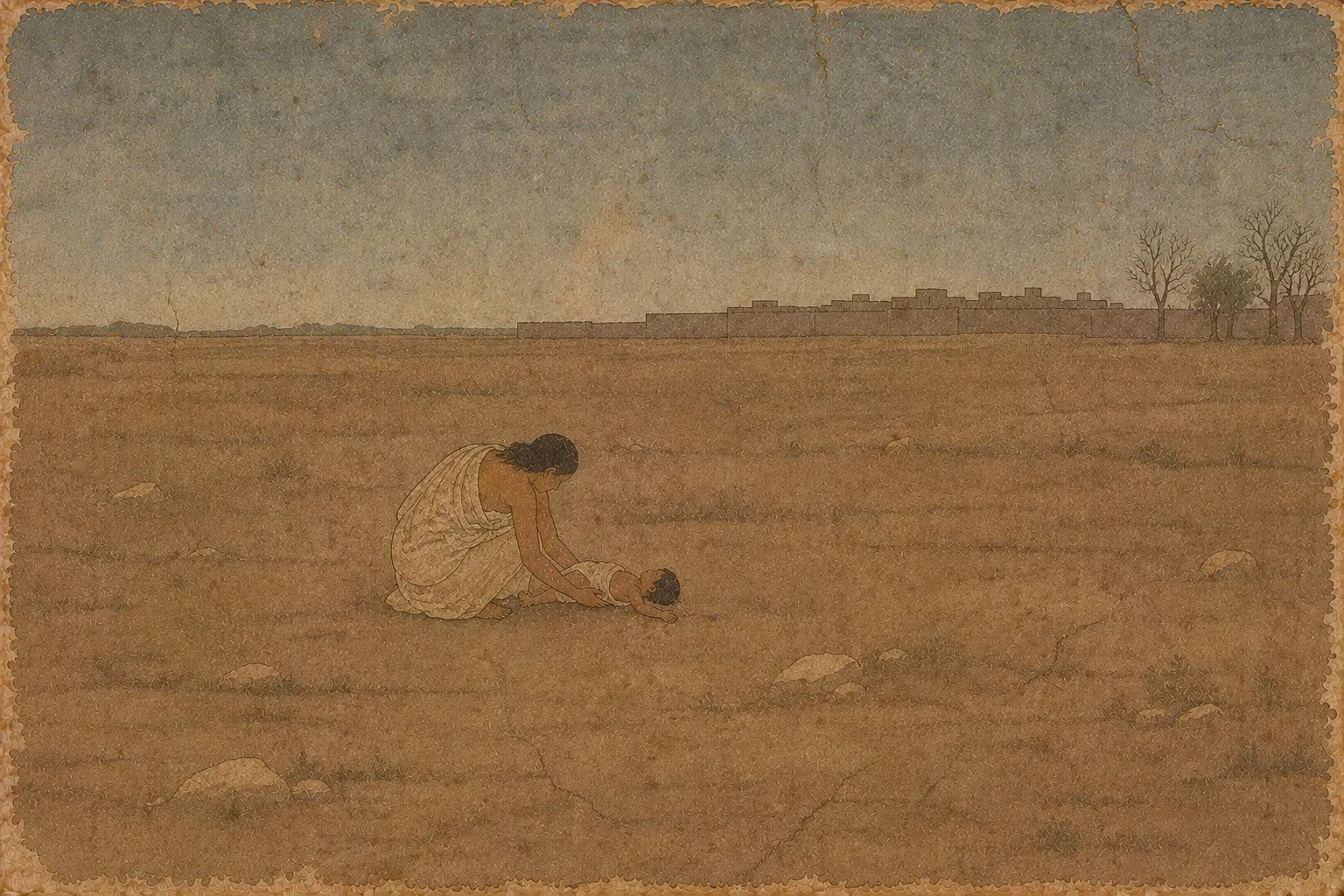
And then she did it herself. She carried him out of the city to the charnel ground and left him there.
That word deserves attention, because “she laid him down at the edge of the city” is gentler than what the sources describe.
A charnel ground, susāna in Pali, was a real and specific place outside an Indian city. It was where bodies went. Some were cremated, which took fuel and therefore money. Many were not. They were left. These were open grounds with bodies on them in various stages of being dealt with by animals and weather and time.
Monks went there deliberately. It was a recognised practice: sit among the corpses and look at them until you understand what a body is. That sounds macabre to us and it was not exactly cheerful to them either, but it was considered useful & the texts describe the stages of decomposition in unflinching clinical detail, because the point was to actually look.
So that is where she took him. Not a graveyard with a marker. An open ground outside the walls where the dead of the city were left.
She put him down on the bare earth and she walked away.
Nobody told her to. In the whole story, not one person ever says बच्चे को नीचे रख दे। The Buddha never says it. She held that body for days, against every sensible person in Savatthi telling her to stop & in the end she stopped because she had got there on her own & there was nothing left to argue with.
This is the centre of the story & it is why it has lasted two and a half thousand years while ten thousand more comforting stories have disappeared.
Nobody can put it down for you.
People can tell you. They can be right. They can be gentle and patient and completely correct & you will nod and say हाँ, मुझे पता है & you will go on carrying it exactly as before, because a thing you have been told lives in your head & the thing you are carrying does not live in your head.
He could have told her. He knew. He was standing there with the answer in his mouth and chose not to say it, because being told the truth and knowing the truth are two different events & the first one can stop the second one from happening.
Tell someone something too early and you do not give them understanding. You give them a sentence & a sentence is a very comfortable thing to hold. You can repeat it to yourself, repeat it to others, sound wise, sound healed & never once look at the thing itself.
The sentence becomes a lid.
This is the single biggest problem with reading philosophy. You can accumulate an enormous number of correct sentences about impermanence and attachment and mortality and the self & walk around fully equipped & none of it touches you, because you acquired it as information. You can quote the thing that would free you. Quoting it is how you avoid it.
No consolation whatsoever
She came back in the morning.
And he asked her one question. सरसों मिली?
She said no.
And then he said the line: that she had thought she was the only one, that she had believed her loss belonged to her alone, something that had happened to her in particular. She had just spent an entire afternoon finding out that it was the normal condition of every house in the city.
Look at what is not in that sentence. No promise that the child is somewhere better. No assurance she will see him again. No reason given for why it happened, no meaning assigned to it, no larger plan it fits into.
No अब वो शांति में है। No भगवान को उसकी ज़रूरत थी। No सब कुछ किसी वजह से होता है।
Not one word of comfort in the way we mean comfort. He does not say your grief is valid. He does not say it’s okay to feel this way. The entire apparatus we have built for talking to people who have lost somebody, the validating and the reframing and the careful words, none of it shows up. Partly because it had not been invented yet. Mostly because it would not have worked.
All he tells her is that she is not special.
Grief does two things at once. It hurts & it isolates. The hurting is real and nothing removes it & he does not try. He does not say one word about the pain, offers no technique for feeling better, makes no suggestion that feeling better is available.
But the isolating is a mistake. It is grief’s one piece of bad arithmetic & you cannot fix bad arithmetic with sympathy. Sympathy offered to someone in that state confirms the error, because sympathy comes from outside. It comes from someone standing in the normal world, reaching across to you in your special terrible place. Every kind word proves the geography. You are over there, they are over here & they are being nice about the distance.
He did not reach across to her. He walked her back.
There is a footnote from modern research that fits here & it is not the one people expect. The famous five stages of grief have not held up. Kübler-Ross built that model watching dying patients rather than bereaved ones & decades of work since have not found that grieving people move through tidy sequential stages. What the field has broadly moved towards instead is continuing bonds: the idea that you do not process a loss and close the file, but carry the relationship forward in an altered form. Which is roughly what happens here. She does not get over her son. She puts his body down and carries him differently. There is no closure anywhere in this story and nobody offers her any.
And notice how he did it. Not with an argument. Not with a claim. With fifty first-hand accounts that she collected herself, by hand, door to door.
She did not believe it because a wise man said so. She believed it because she had counted.
But isn’t that cruel?
There is a real case against everything I have just said & any honest telling has to face it.
The case is this. A woman is in the worst hour of her life & a man sends her on a pointless walk around a city carrying her dead child in the heat, knowing perfectly well that she will fail, so that she can learn a lesson. That is not compassion. That is a teacher who wanted his point made. And he lied to her, straight out. He said he could cure the boy. He could not. He used her hope as a mechanism to get her moving. And the lesson itself, put in plain words, sounds less like wisdom and more like the thing an unkind person says to shut you up.
सबके साथ होता है, इतना ड्रामा क्यों।
We have all heard that one. It is among the worst things you can say to someone who is grieving.
There is a sharper version of the objection too. Look at who this happened to. A poor woman, mocked for her body, scorned by her in-laws, with no power anywhere in her life, is given an instruction by the most authoritative man in the region & she obeys it. She walks around the city with a corpse in the sun because a powerful person told her to. Told from that angle it is not a story about wisdom at all.
None of that is stupid & I have gone back and forth on it.
Here is where I land. The difference between सबके साथ होता है and what he did is the difference between a claim and an experience. When someone tells you everyone suffers, they are asking you to accept a general statement about the world while you are in specific pain. It lands as dismissal & it should, because it is dismissal. It is a way of ending the conversation and getting back to lunch.
He never made the claim. He arranged for her to find it out. One closes a door. The other opens fifty of them.
And the lie, which was a lie, was the only thing that could have got her walking. Tell her the truth and she stops listening and goes to the next house asking for medicine, which is precisely what she had been doing all week to everyone who told her the truth. Her mind had already rejected the truth from a dozen people. He needed her to move through that city & hope was the only thing that could move her, so he used it.
As for the power objection: she did obey him. But she also, at the end of it, put the child down without being told to. If this were only obedience she would have needed the instruction. She did not. He gave her a walk and she did the rest of it herself.
Still. I do not want to tidy this up.
There is something a little frightening in this story and it should stay frightening. It is not a warm story. Nobody in it is comforted. The kindest act in the whole thing is disguised as a trick & you only find out that it was kindness much later, from outside, after it has worked.
Which raises the obvious question about the man who did it.
The man who had already done the same thing
There is a fact about the Buddha that sits very strangely next to this story & I’ve never seen anyone put the two together. He lost his own mother when he was seven days old. That’s the traditional account: Maya died a week after giving birth to him & he was raised by her sister, Mahapajapati. Take it as tradition rather than documented history (almost everything biographical about him is), but it’s what the tradition says & it’s consistent across sources. So the man telling this woman about the universality of death was himself a motherless infant, raised by an aunt, who would have grown up knowing that his own birth was the event that preceded his mother’s death.
And there’s a second thing, harder. He had a son. Rahula. And according to the traditional account, he left home when that child was a newborn, walked out of the palace in the night, away from his wife and his infant son, to go and find out what he went and found out. Years later he came back & Rahula was brought to him & he ordained the boy as a novice. The child’s grandfather, Suddhodana, was reportedly upset enough about losing his grandson to the order that he asked the Buddha to make a rule about it: no more ordaining children without parental consent. The rule exists.
So hold the two images together. A man who walked away from his own child, telling a woman she must let go of hers.
I’m not saying this to score a point. It’s more interesting than that. Because the obvious hostile reading, easy for him to say, actually gets it backwards. He wasn’t asking her to do something he hadn’t done. He was asking her to do something he had done, deliberately, by choice, to himself, at enormous cost & which he apparently thought was the only thing worth doing. Whether that makes it better or worse is genuinely up to you. Some people read his departure as the great renunciation and some read it as a man abandoning a baby & both readings have been available for two and a half thousand years & the tradition itself is not entirely comfortable about it, which is why there’s so much later literature working hard to explain it.
Her own poem says something much worse
Here the story you know and the story in the sources come apart & the gap is not small.
The mustard seed version, the famous one, told everywhere, comes from the commentary on verse 114 of the Dhammapada. A commentary, not a recorded talk, compiled around the fifth century CE from older Sinhalese material. That puts the compilation something like nine centuries after the events it describes, though the Sinhalese material behind it is older and nobody can say how much older, so treat the gap as an outer bound rather than a measurement.
It is also not the only version. There are four: a very short one in the Samyutta material, one in the Anguttara commentary, the longest in the Therigatha commentary & the Dhammapada one that became famous. They differ in ways that matter.
And then there are her own verses.
The Therigatha is a collection of poems in the names of the earliest Buddhist nuns & the poem standing under Kisa Gotami’s name in the canon does not describe one dead child.
It opens on friendship, the value of good company, how even a fool sharpens up around people of quality. Standard enough. Then it turns & becomes one of the bleakest passages about women’s lives anywhere in ancient literature. It says that the state of being a woman is painful & attributes that judgement to the Buddha himself. It talks about the particular misery of being one wife among several. And then it gets specific in a way that stops you cold: some women, having given birth once, cut their own throats. Others, more delicate, take poison. And in a breech birth both of them die, mother and child together.
That is in the canon, in a woman’s voice, two thousand years old & nobody quotes it. Every retelling of Kisa Gotami quotes the mustard seed and skips the poem & the poem is the part that was actually attributed to her.
Then it moves into her own losses.
द्वे पुत्ता कालकता, पती च पन्थे मतो कपणिकाय। माता पिता च भाता, डय्हन्ति च एकचितकायं॥
She was travelling, about to give birth. She saw her husband dead. She gave birth on the road and never reached home. Two children dead. Her husband dead on the road. Her mother, father and brother burning together on a single pyre.
Not one child. A whole family, gone, with one of the causes putting three of them on the same fire at the same time.
And then a line that is hard to read. She says she saw, in the middle of the charnel ground, the flesh of her sons being eaten. She went there and saw what was happening to her children.
The woman in the famous version is holding one small body and refusing one death. The woman in this poem has lost everybody and then gone out to the burning ground and watched the animals at work. तुम अकेली नहीं हो means something very different said to her.
The poem ends the way these poems end, with the practice and the release & in the final movement she uses two images. She says she pulled out the arrow. And she says she set the burden down.
She put it down. In her own verse, under her own name. Everything anyone says about this story, that nobody can put it down for you, that she carried it until she stopped, is not a reading laid over the text. It is her own word for what happened.
And then the poem signs itself.
I, Kisa Gotami, have said this.
The two women
So which is true? One child or six people?
To answer that you need to hear the other story, because the poem above is an almost exact description of a life that the commentaries assign to a completely different nun. Her name was Patacara & hers is the worst story in the Pali canon.
She was the daughter of a wealthy family in Savatthi, kept closely guarded & promised to a man of equal rank. She was in love with one of the household servants. So on the morning of the wedding she dressed as a servant herself and ran away with him. They lived poor in the countryside. She had a son. Then she became pregnant again and wanted to go back to her parents’ house to give birth, because that’s what you did & because she must have wanted to be forgiven. Her husband was afraid of her family and refused. She set off anyway, with the child. He followed and gave in.
On the road she went into labour during a storm. Her husband went to gather wood and grass to build a shelter. A snake bit him. He died there. She gave birth in the open, in the rain, with no shelter but her own body over the two children & waited all night for a man who was already dead. In the morning she found him. She kept going towards Savatthi. The river Aciravati was in flood from the night’s rain. She couldn’t carry both children across at once. So she left the older boy on the near bank, carried the newborn across, set him down on the far side & started back for the first one.
Midstream, a hawk saw the baby on the bank and took him for meat. She saw it coming and raised her arms and screamed to frighten it off.
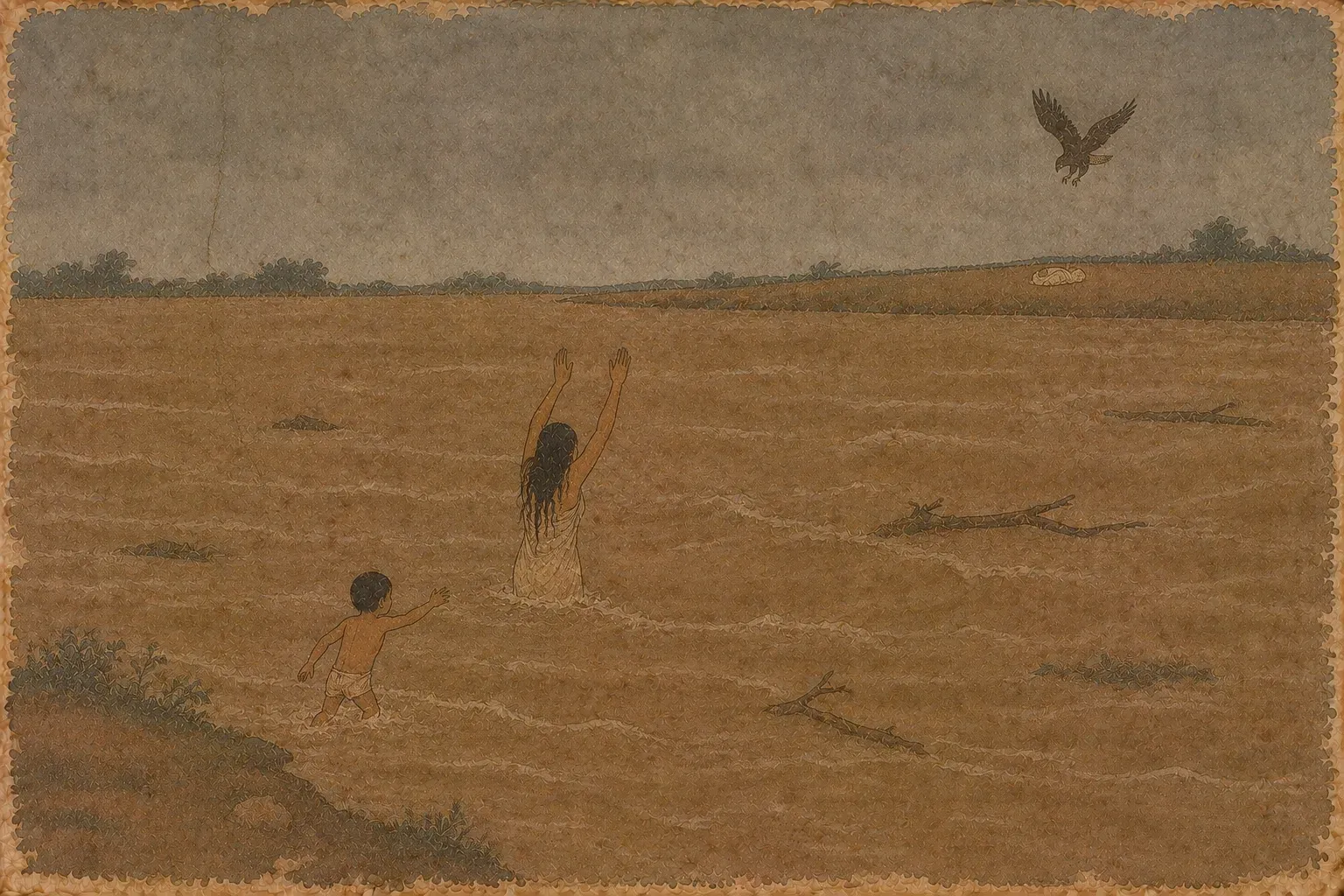
Her older son, on the other bank, saw his mother’s raised arms and heard her calling and thought she was calling him to come. So he stepped into the flooded river.
The hawk took the baby. The current took the boy. She stood in the middle of a river and watched both of her children go, in the same moment, because of the same gesture. Her own gesture.
She went on towards Savatthi because her parents were there. On the road she met a man from the city and asked about her family & he told her their house had come down in the storm the night before, that her father and her mother and her brother had been killed & that they were being cremated at that moment on a single pyre.
She could see the smoke.
And at that point her mind went. She tore off her clothes and wandered naked through the city & people threw things at her and called her the mad woman & that is how she was living when she came across a crowd where the Buddha was speaking. The crowd tried to keep her away. He told them to let her come. Someone threw her a cloth. She covered herself and sat down.
That is Patacara. The commentaries give her that life & she goes on to become foremost among the nuns in mastery of monastic discipline, which for a woman who had been the city lunatic is its own kind of statement.
Now put the two together. The commentaries say: mustard seed for Kisa Gotami, the river and the hawk for Patacara. The canonical verses say: the river and the hawk belong to Kisa Gotami.
Same story, two names & the sources contradict each other.
Why nobody fixed it
Here’s what happened, as best anyone can tell & it’s the part I find genuinely moving.
Thanissaro Bhikkhu, who has translated these verses, offers the most likely explanation: the commentarial stories were probably imported from other Buddhist traditions: schools outside the Pali line, with their own versions of who did what. Those traditions assigned the destroyed-family story to Patacara. The Pali canon assigned it to Kisa Gotami. The commentators, working centuries later, drew on the outside material. Which left them with a commentary that contradicted the very verses it was a commentary on.
And here is the thing.
They didn’t fix it. They could have. It would have been trivially easy. Change a name in the verse, or quietly adjust the commentary & the problem disappears forever and nobody in two thousand years is any the wiser. That is exactly what happens to most texts, in most traditions, most of the time. Inconsistencies get sanded off by people who assume they’re errors. Instead they left both versions standing, visibly disagreeing with each other, for anyone to notice.
Later Theravada writers did try to patch it: they argued that the family-destruction passage in Kisa Gotami’s verses is actually Patacara speaking, butting in mid-poem. Thanissaro dismisses this fairly briskly & you can see why: it’s an odd thing for one arahant to interrupt another’s autobiography. But the patch came later. The original transmitters just let it stand. Which tells you something about the men who carried this material for four centuries with nothing but their memories. They were not writing scripture to be tidy. They had inherited words, they believed the words mattered more than their own opinion of the words & when the words disagreed with their own commentary they preserved the disagreement rather than the coherence. That is a very high standard. Higher, frankly, than a lot of what gets published now.
And there’s a second thing, which is the point I’ve been building to. If the destroyed-family story is Kisa Gotami’s (and in the canon, it is), then the mustard seed story may have started life as this story & narrowed. Six deaths became one death. A river and a hawk and a burning house became a child who tripped in the street. Here’s my guess at why & I think it’s the most human thing in this whole account.
One child, you can bear to read about. One child is a story a teacher can tell to a room & the room will follow it & learn from it & go home and sleep. Six people, three of them on one pyre & a woman standing in a river watching both her sons die because she raised her arms: that is not a teaching story. That is horror. Nobody learns anything from it, because the mind closes. You’ve probably felt it closing a few paragraphs ago. So somewhere across those centuries, in retelling after retelling, it may have narrowed. Not out of dishonesty. Out of the same instinct that makes you soften something before you say it to a child.
The story was being passed down to be useful. And to be useful, it had to be survivable. Which means the version that reached you has already had done to it the exact thing the story is about.
कोई नाकाबिल-ए-बर्दाश्त चीज़, बर्दाश्त के लायक बनाई गई — ताकि उसे उठाया जा सके।
Becoming a nun was not simple
After the charnel ground she came back and asked to be ordained.
In most retellings that is a single sentence. She became a nun. It was not a single sentence. For a woman at that moment in that movement it was a live political question & she was joining an order that had only just been forced into existence. The story of how women got in at all is one of the most uncomfortable passages in the Pali canon & the canon preserves it without cleaning it up.
Mahapajapati, the Buddha’s aunt and the woman who raised him after his mother died, asked him to allow women to ordain.
He refused.
She asked again. He refused. She asked a third time. He refused again & left the city.
So she cut off her hair, put on the robes anyway & walked to Vesali on foot with a large group of women. The sources say five hundred, which in Pali often means no more than “a lot”. She stood outside where he was staying, crying, covered in road dust, her feet swollen from the walk. Ananda, his attendant and cousin, found her there and went in to intercede.
He was refused twice. On the third attempt he changed tactics and asked a different question.
क्या औरतें जाग सकती हैं, या नहीं?
And the Buddha said yes. They are capable of it.
तो फिर उन्हें दीक्षा क्यों नहीं?
And he relented.
But he attached eight conditions, the garudhammas & every one of them put nuns under monks. The most quoted: a nun ordained a hundred years must show deference to a monk ordained a single day. Nuns cannot formally admonish monks. Monks can admonish nuns.
The scholarship here is contested. Bhikkhuni Kusuma, among others, has pointed out serious inconsistencies. The eight rules are not mentioned where you would expect them in the Sinhalese chronicles & several of them appear elsewhere in the Vinaya as having been established much later than Mahapajapati’s ordination, which means they cannot have been the conditions set at the time. There is a real case that the eight-conditions framing was retrofitted, later, by people with an interest in the outcome.
Either way, this is the door Kisa Gotami walked through. An order that had to be argued into accepting her, on terms that ranked her permanently below any man in it. She joined it & stayed & by every account practised hard for years.
One small detail is hard to let go of. Mahapajapati is also called Gotami. So is Kisa Gotami. So is the Buddha himself, since Gotama is the clan name. The story is full of Gotamis: the aunt who raised him, the thin woman who lost her son & him.
That is probably nothing. Common name, common clan. But there is something in it.
Mara at the edge of the forest
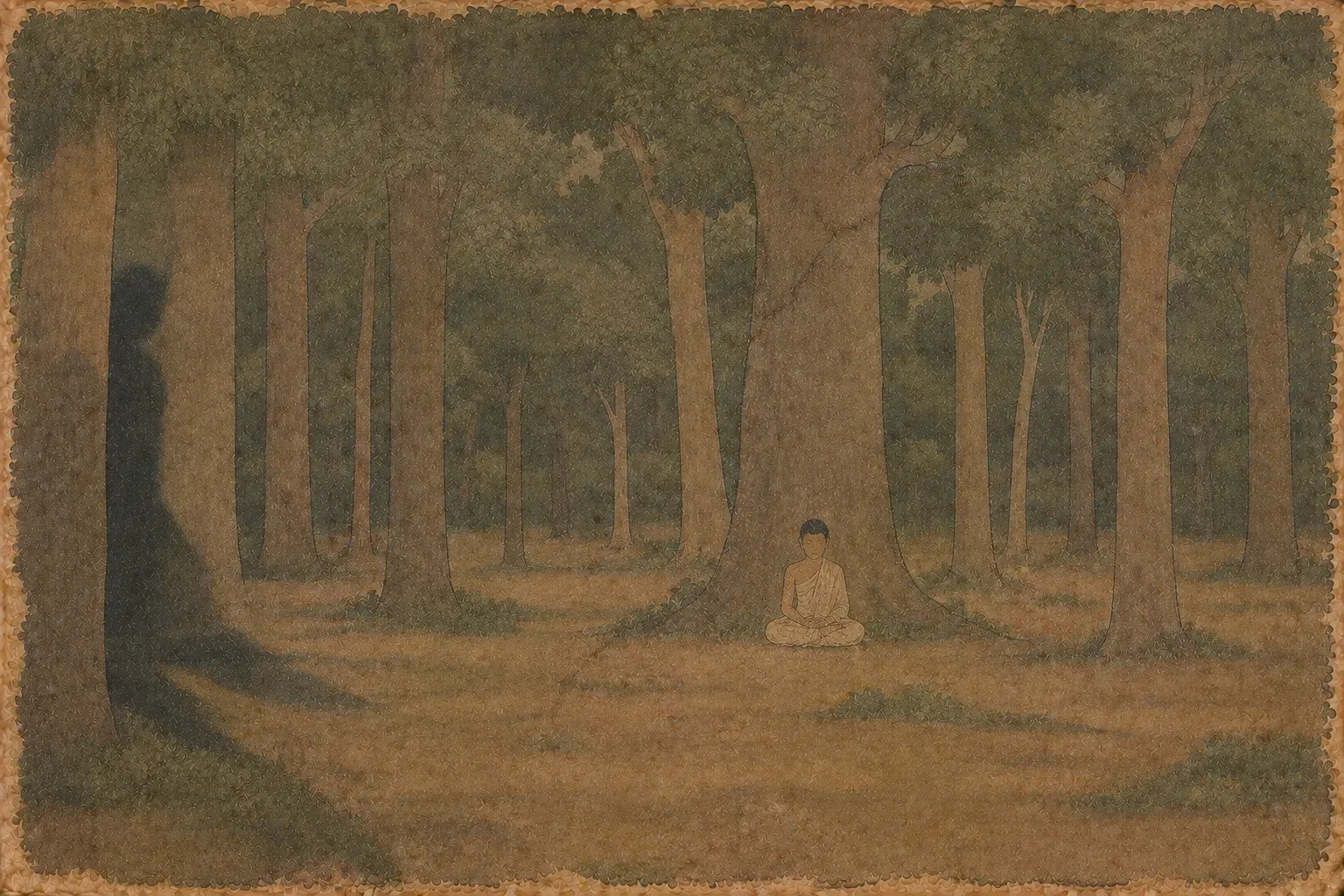
There is exactly one place in the early discourses, not the commentaries but the actual canon, where we get a scene of her as a nun, in prose, doing something. It takes about ninety seconds to read & it is one of the strangest things in the collection.
Morning in Savatthi. She puts on her robes, takes her bowl & walks into the city to beg for food. She does the round, comes back, eats. Then she goes out to a wood called the Grove of the Blind, walks deep into it & sits down at the foot of a tree to spend the day.
And Mara comes.
Mara in this literature is the adversary, sometimes a figure, sometimes plainly a state of mind, usually both at once and deliberately left ambiguous. His job is to pull people off. The text says plainly what he wants: to frighten her, to raise the hair on her body, to break her concentration.
He speaks to her in verse. Two hits in one breath.
क्यों बैठी है यहाँ अकेली, मुँह भीगा हुआ, जैसे किसी के बेटे मर गए हों?
And then, without a pause:
अकेली, जंगल के अंदर — मर्द ढूँढ रही है क्या?
He goes straight for the dead children. And then, immediately, he suggests that a woman sitting by herself in a wood is sexually available, or desperate, or both. That is not a metaphysical temptation. It is street harassment, aimed at the one thing that broke her and the one insult that followed women who left their households.
Note that he says sons, plural. The Pali is genuinely ambiguous about number and translators split on it, but the plural reading sits far closer to her own poem than to the commentary’s single child. Even here the two versions of her life pull against each other.
Now watch what she does.
She does not answer him.
Her first move is to work out what she is dealing with. The text gives us her thought. Who said that: a person, or something that is not a person? And then: this is Mara. He said it because he wants to frighten me and break my concentration.
She identifies the voice before she responds to it.
Only then does she reply & her reply is calm to the point of being almost bored. She says she is past the death of sons and past looking for men. She says she does not grieve and does not weep and is not afraid of him & she calls him मित्र while she says it. She says delight has been destroyed everywhere, the mass of darkness is broken & that having beaten the army of death she lives without stain.
Mara realises that she knows who he is. And he leaves, described as sad, dejected and disappointed & vanishes on the spot.
He does not lose an argument. She never refutes him. He loses because she named him.
Everybody has that voice. It arrives when you are alone and quiet, which is exactly when she was sitting under that tree & it says the cruellest available thing in your own accent. Look at you. Still crying about that. What are you even doing out here. It attacks the wound, then adds a second insult about your character for having the wound.
The instinct is to argue with it, to defend yourself, to justify why you are sad, to prove you are not pathetic. Which never works, because arguing grants it standing. You have accepted that a prosecution is underway and that you are the defendant.
She stops and asks what is speaking. Who is this: a person, or not a person? And the moment it is identified as a voice rather than a verdict, its power is finished. It becomes a thing happening to her rather than a truth about her.
Then she answers it politely, as मित्र, the way you would answer someone you have completely stopped being afraid of.
And it goes away embarrassed.
This is a two-and-a-half-thousand-year-old text describing, with total precision, the difference between having a thought and believing a thought. There is a whole modern therapeutic industry built on that distinction. It is sitting here in ninety seconds of prose about a woman under a tree in a wood called the Grove of the Blind.
दीये
There is one more piece, the one that gets dropped most often & it is the one that convinces me there was a real woman here.
The story would normally end at the mustard seed, with the neat finish. She understood, she woke up, she found peace.
It does not end there. The text is clear that the mustard seed was not the end of anything. It was the start of her practice. She had put the body down. She had not finished.
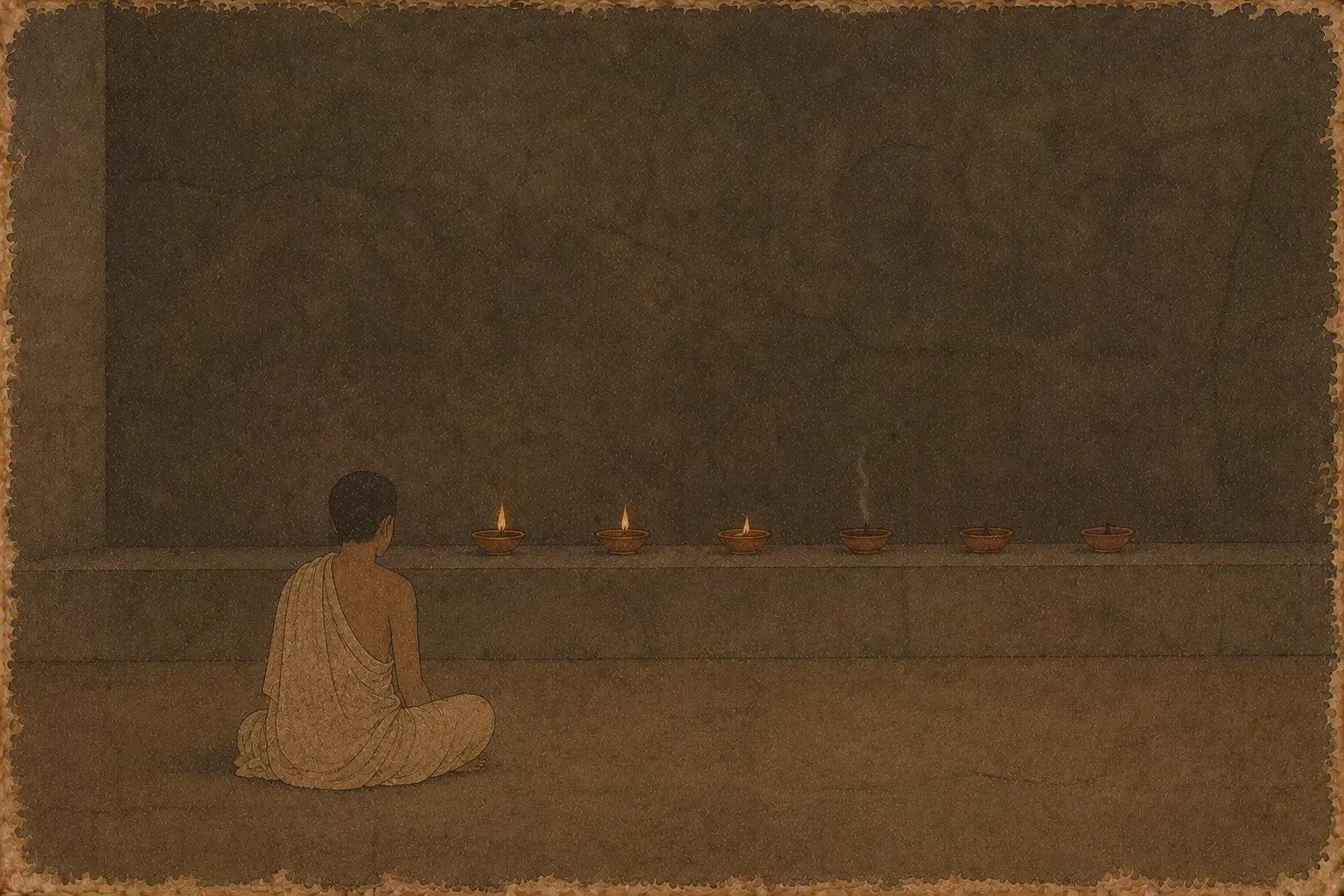
And later, the account says, she was watching oil lamps. Small clay दीये, the kind lit at every threshold in that city, the kind she had walked past thirty of on the afternoon of the errand without seeing a single one. Some were flaring up. Some were nearly out. Some had already gone dark.
And watching them, she saw it again. On her own, with nobody sending her anywhere.
जल रहे हैं, बुझ रहे हैं। बस इतना ही है।
As a story that detail ruins the shape. If you were making this up you would end at the mustard seed, where the lesson lands and the audience nods. Adding a second realisation years later, with a completely different image, involving lamps, is exactly the kind of thing nobody invents.
It is the kind of thing somebody remembers.
The first seeing was arranged for her. Somebody designed the errand, picked the ingredient, set the condition, sent her out. Brilliant teaching & still something done to her.
The second seeing was hers. Nobody set it up. She was sitting somewhere looking at a row of दीये, the way you might look at traffic or a ceiling fan & the thing she had learned once from fifty doorways arrived again from a few small flames. Unasked.
The first time, you need an entire city.
The second time, एक दिया काफ़ी है।
The word for a lamp going out
I need to tell you something about that image, because it is not a coincidence and it is not a metaphor somebody chose. It’s built into the language.
The Pali word nibbāna (the word we’ve turned into “nirvana” in English, the thing the whole religion is pointed at) does not originally mean bliss, or heaven, or paradise, or a state of cosmic oneness. Open the Pali dictionary and the first meaning listed is this:
The going out of a lamp or a fire.
That’s it. That’s the root sense. In the Buddha’s period the word even had its own verb, nibbuti, which meant to go out the way a flame goes out.
A burning fire was not thought of as free. It was thought of as trapped. It clings to its fuel and is held by its fuel at the same time: it cannot let go of the wood and it cannot exist without the wood & so it burns, hungrily, in a state of being caught. Starve it, cover it, take away the fuel & it goes out. And going out is not death. Going out is release. The fire is unbound.
And the word for what’s left afterwards is coolness. Sītibhūta, become cool. When the texts describe someone who has arrived, they say: my fire is out. I have become cool.
So sit with what she was actually looking at.
A woman who had spent days carrying a child she could not put down (clinging to it, held by it, unable to exist without it & burning) is sitting in front of a row of small clay lamps. And one of them runs out of oil and goes quiet.
She wasn’t watching a nice image that reminded her of a teaching. She was watching the literal event that the word for her own goal was made from. The lamp going out is nibbana. Not like it. It’s the thing the word was built to describe.
The fire clinging to its fuel was her. The child was the fuel. Putting his body down at the charnel ground was the flame going out.
And what comes after is not happiness, exactly. It’s cooler than that. It’s what the Pali actually says: the heat stops.
How this reached you
Nothing was written down. Not for a very long time.
The Buddha wrote nothing. Writing existed in India in his period, but the tradition was oral by choice rather than by limitation. Teachings were memorised & specialists called bhāṇakas were responsible for particular sections, one group carrying these collections and another group carrying those. The texts are full of repetition and formulaic phrases and numbered lists precisely because they were engineered for memory & the repetition that makes them tedious to read is what made them survivable.
This went on for roughly four hundred years.
Then, in about 29 BCE, in Sri Lanka, during a period of famine and war when the monks who held the material were dying and the transmission was genuinely at risk of breaking, the decision was made to write it down.
It happened at a cave monastery called Aluvihara, near Matale. The traditional account says five hundred monks worked on it. They scratched the text onto prepared palm leaves with metal styluses, then rubbed ink made from berries over the whole surface and wiped it off, so that the colour stayed only in the scratches.
Pali has no script of its own. So Pali was written down in Sinhala letters.
Some scholars think the “Fourth Council” framing came later & that this was less a grand convocation than a gradual change which conservative monks probably resisted at the time. The oral tradition did not stop. The bhāṇakas carried on alongside the manuscripts for centuries. Writing gave memory a backup.
Then, in the fifth century CE, a monk named Buddhaghosa arrived at the great monastery in Anuradhapura and set about the commentaries. The explanatory material had accumulated in Sinhalese over centuries. He worked it back into Pali, compiling and organising as he went & his versions became the standard ones. The older Sinhalese material he was working from is now lost. We have it only through him.
The mustard seed story comes from that layer.
So the chain runs roughly like this. A woman in Savatthi, whoever she was. Poems recited and carried in memory. Four centuries of oral transmission by specialists. A famine & palm leaves & styluses & ink made from berries, in a cave in Sri Lanka. Centuries of commentary in Sinhalese. A monk in the fifth century turning it back into Pali. Manuscripts copied by hand, over and over, decaying in the tropical damp and being recopied, for another fourteen hundred years. European scholars in the nineteenth century. Translations. Your screen.
At no point in that chain was there a single point of failure that could not have quietly deleted her.
She is only here because of a very long series of people deciding that these particular words were worth the trouble.
The first book in the world written by women
One last thing, because the container this story survived in is almost as remarkable as the story.
The Therigatha is seventy-three poems in sixteen chapters, in the names of the earliest Buddhist nuns. It sits inside the official Buddhist collection and has for two thousand years. The material was composed over a long stretch (scholars place the range somewhere between the sixth and third centuries BCE) and written down with the rest of the canon around the first century BCE. The dating is genuinely unsettled and you should hold it loosely. But this much isn’t disputed: it is the first collection of women’s writing anywhere in the world. And among all the world’s religions, it stands alone: a scripture written by women, kept as scripture.
Not written about women. Not written for women. Written by them. Kept, passed down, recited & eventually written out. Still there.
And read what those poems are actually about and they stop feeling ancient at all. Getting old. Losing your looks. The body changing and what that does to you. Not having children. Having them. Depression. Friendships that survived the move out of household life into the order. Teachers and students, women both. Sexual desire, discussed with a frankness that would get you moderated on most of the internet. And grief, in enormous quantity. These are not floaty spiritual poems. These are women writing about their lives with a plainness that is honestly a bit startling. Some scholars used to doubt women wrote it at all. Kathryn Blackstone compared the language of the Therigatha against the Theragatha, the companion volume by the monks. They come apart sharply. Different images, different word choices, far more about family and personal loss. And noticeably fewer references to the Buddha, which is the detail I love.
The tradition also says she ended up known as foremost among the nuns who wore the roughest cloth: the coarsest, cheapest thing a person can wear. There’s a past-life story attached, explaining that she’d made a vow about it lifetimes earlier. That kind of past-life vow is a standard template in this literature; Mahapajapati has one with an almost identical structure. So read it as the tradition’s way of saying this was her particular distinction, rather than as history. But the distinction itself is the thing. The woman who was mocked for having no flesh on her. Who was married into a house that thought she was worthless. Whose entire standing in the world rested on a child who died before he could run.
She ends up remembered across the whole tradition as the one in the roughest cloth. On purpose. As an honour.
जो चीज़ उसकी कमी थी, वही उसकी पहचान बन गई।